Bishopscourt Blinds / The Playbook
The Bishopscourt Light & Damp Playbook
A window-by-window field guide to shading a Bishopscourt home — how the oak canopy, the low winter sun and one of the wettest microclimates in the city change what belongs on each elevation. Written for this address, not lifted from a catalogue.
This guide is also a PDF you can download and read offline (11 pages).
Why Bishopscourt is a shading problem of its own
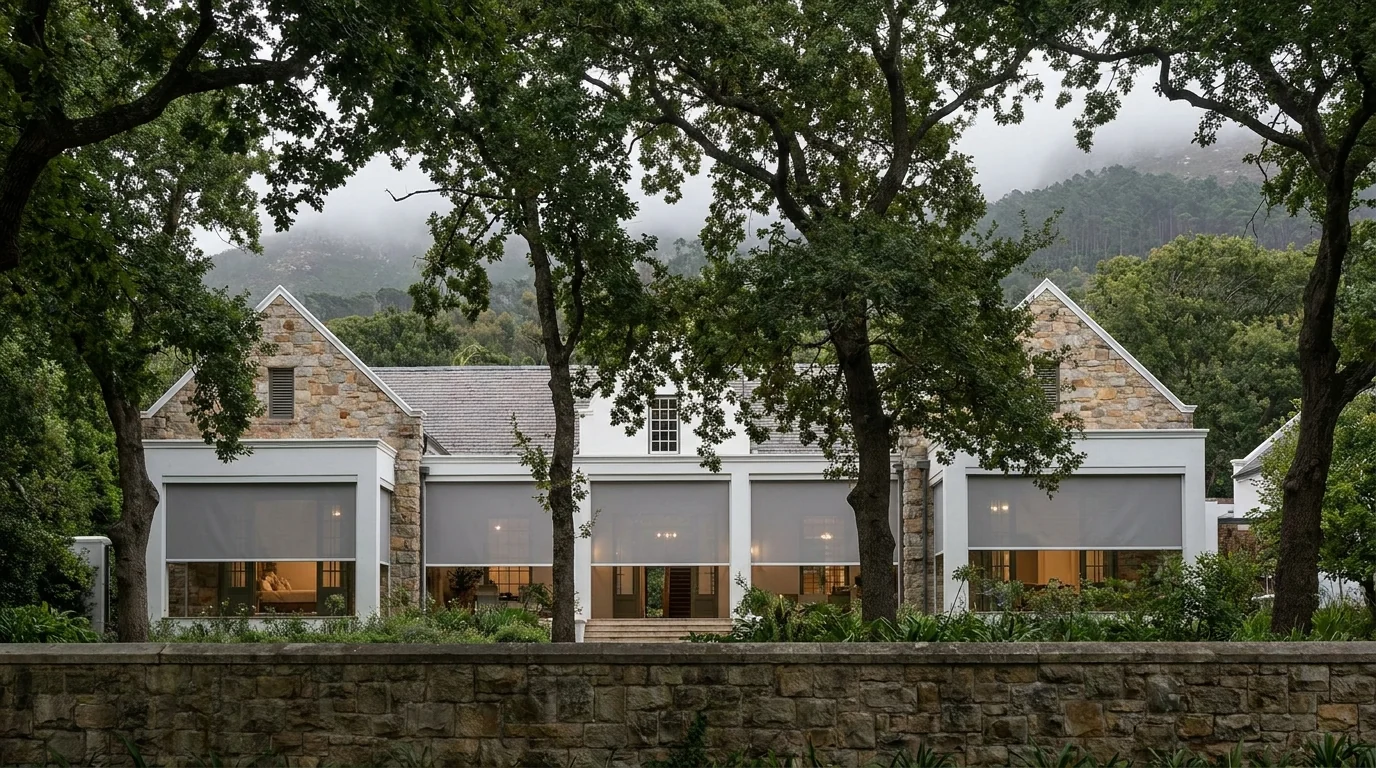
Bishopscourt is roughly 350 houses, most of them on more than an acre, pressed right up against Kirstenbosch and the forest at the foot of Table Mountain.
From the road the suburb is mostly wall, hedge and oak, with almost no visible building line. Behind them sit three different kinds of house: Cape Dutch-revival estate homes, mid-century architect-designed houses, and newer double-storey contemporary builds carrying a lot of glass. One shading approach across all three, and all four elevations, gets two of them wrong.
Two things make the light here unlike the drier suburbs a few kilometres away. The oak and indigenous canopy filters direct sun into a shifting dapple for much of the day. And this is one of the wettest corners of the city — the eastern, leeward slope that Bishopscourt shares with Newlands next door takes some of the highest rainfall in the country, up towards 2 000 mm a year against under 600 mm on the Atlantic side of the mountain. So the brief is rarely “block the sun”. It’s closer to keeping the view and the light, cutting glare and heat off the big glass, and using hardware that survives years of damp. This guide walks it, elevation by elevation.
A high summer sun, a low winter one, and a hard west afternoon
Cape Town sits at about 33.9° south, so the sun is in the northern sky at midday and swings a long way through the year. At the December solstice the noon sun stands nearly overhead — roughly 79° above the horizon — which means a north-facing window is easy to shade with the eave already above it. At the June solstice it drops to about 33° and rakes low across the northern sky all day, reaching deep into north-facing rooms — often welcome winter warmth.
The elevation that catches people out is the west. In summer the late sun comes in low and hard, under any eave, straight onto the glass — from about three until it drops behind the oaks. Summer midday UV in Cape Town runs very high to extreme, which is what fades fabric and loads heat through unshaded glazing. Wind arrives from two directions on a schedule: the south-easter — the “Cape Doctor” — blows hardest from November to February, and the winter rain rides in on north-westerly gales. Bishopscourt is partly screened by the mountain and the trees, but exposed terraces and upper windows still feel both. Salt, honestly, is a minor worry this far inland compared with the Atlantic seaboard — here the hardware enemies are damp and wind, not sea corrosion.
Which side of the house you’re standing on changes the answer
The sun-catcher
High and easy to shade in summer, but the low winter sun pushes right in — so you want to temper glare without losing the warmth you actually want in July. Sunscreen keeps the light and the garden; blockout is for the north bedrooms that need to stay dark past a five-o’clock summer sunrise.
The hard one
Low summer afternoon sun, under the eave, onto whatever glass faces the garden or the mountain. Stopping that heat outside the glass beats absorbing it inside. External shade, or a serious sunscreen, earns its place here more than on any other wall of the house.
Bright early, calmer later
Morning glare on breakfast rooms and east bedrooms, then an easy afternoon. A sunscreen or a light-filtering cellular takes the edge off the early sun without darkening the room for the rest of the day.
Cold and damp, not glary
Little direct sun, and the coldest, dampest rooms in a canopy-shaded house on this wet slope. Here the job is warmth and moisture tolerance, not glare — cellular honeycomb and sealed-finish hardware, not a fabric that will hold damp.
The recommendations, with both sides of every trade-off
Every choice below is a trade-off, so we’ve put both sides of it. Tap Add on any recommendation to drop it into the ballpark tool and the free-measure list below — so you carry what fits straight into either path, no retyping.
West heat: external shade over an interior blockout
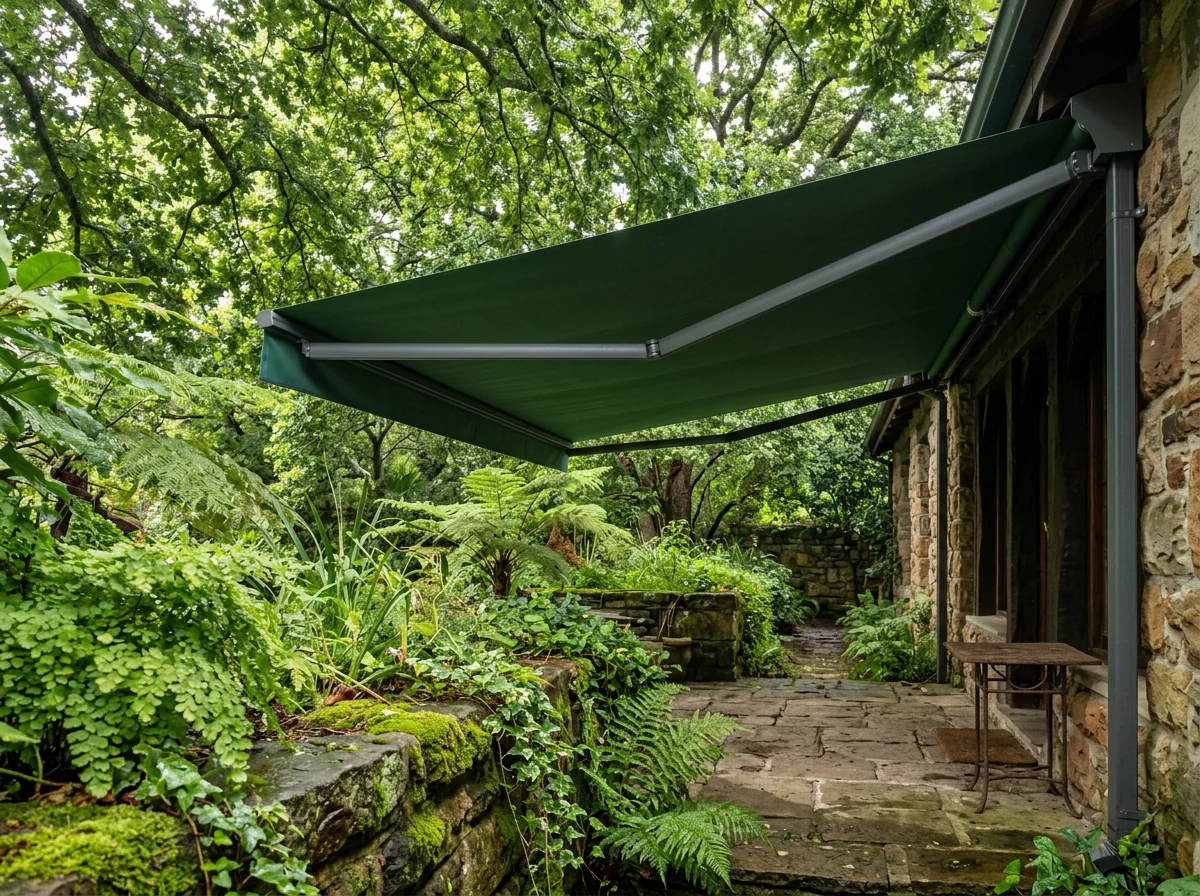
On a hot west elevation we’d usually stop the heat outside the glass — a folding-arm awning over the terrace, or a zip screen that runs in a side channel and stays taut in the south-easter — rather than an interior blockout roller. The reason is physics: an external screen intercepts the sun before it reaches the pane, while an interior blockout only stops the light after the glass has absorbed the heat and begun radiating it inside.
The honest trade-off the other way: external shading costs more, wants a motor and a wind sensor to survive the wind here, and a zip screen does change the look of the elevation. If budget or the façade rules it out, a high-performance sunscreen roller inside is the next best thing, with a blockout behind it for the evening.
The garden view: a sunscreen roller, not a plain blockout
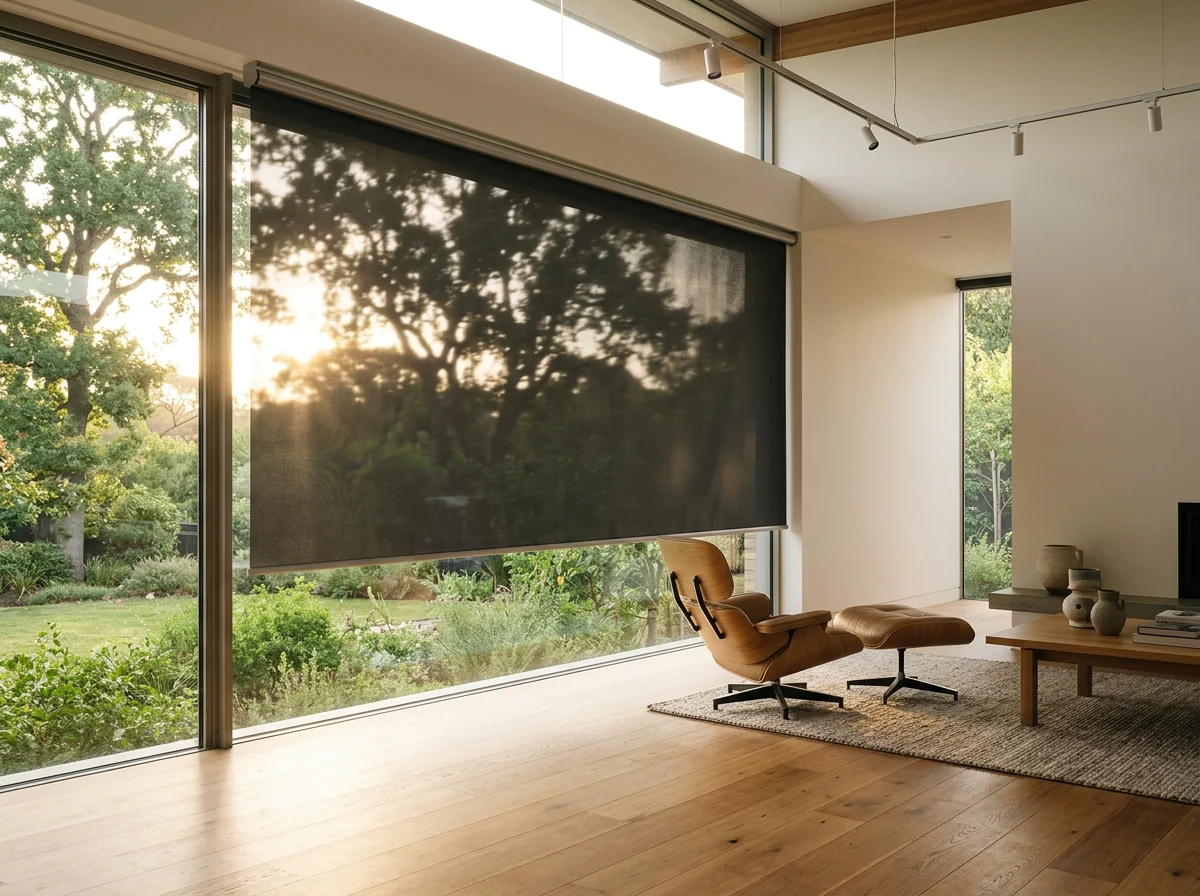
Most of the glass in a Bishopscourt house exists to see the garden, so an opaque blockout on the living-room windows solves glare by throwing away the reason the window is there. A sunscreen mesh cuts glare and UV and keeps the oaks and lawn visible as a soft silhouette, its weave chosen against how close the view sits to the window.
The honest trade-off: a sunscreen is not a privacy blind after dark — once your lights are on and the garden is black, people outside can see in more than you’d like. That’s exactly why the day-and-night double roller further down exists.
Bedrooms: blockout roller, or blockout cellular where the room runs cold
A north or west bedroom needs to stay dark past a bright summer dawn, and a blockout roller does that cleanly. But on this shaded, damp slope many bedrooms are also genuinely cold, and there a blockout cellular honeycomb earns its place: the pleated cells trap still air at the glass, giving darkness and a real insulating layer in one blind.
The honest trade-off: the cellular costs more than a plain roller and the fabric is more delicate to clean; if the room isn’t cold, the plain blockout roller is the sensible spend.
Older joinery: timber venetian versus sealed aluminium
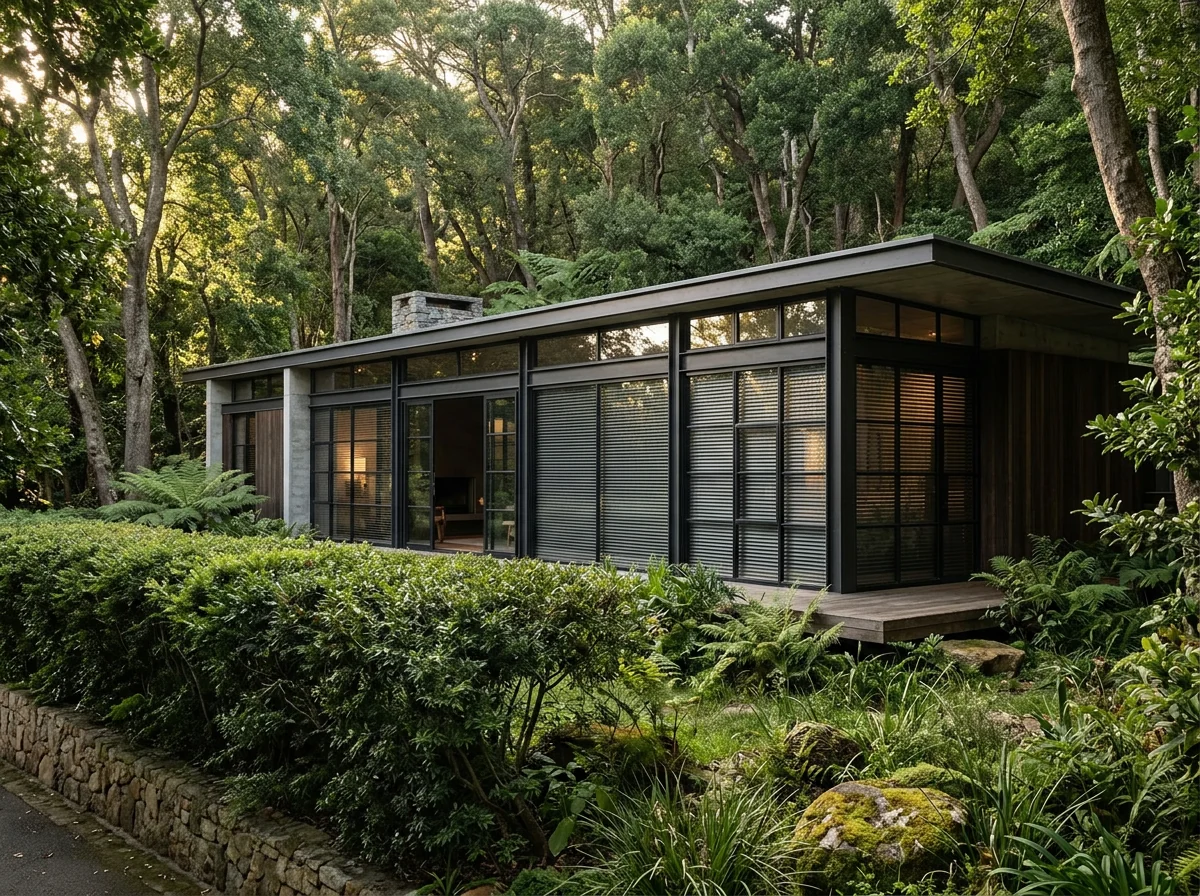
On Cape Dutch-revival sashes and mid-century steel casements, a wide-slat timber venetian tilts the dappled canopy light where you want it and suits the age of the reveal — the better-looking answer on original joinery, provided the room stays reasonably dry.
The honest trade-off: in a bathroom, a kitchen, or a cold south room that sweats through a wet winter, raw timber is the wrong call — it will move and mark. There we’d switch to a slim aluminium venetian with a sealed finish, which tilts the same way and shrugs off the damp. Same product family, opposite room.
Cold, damp south rooms: cellular honeycomb
The south and deeply canopy-shaded rooms are where this slope’s microclimate bites — low light, little sun, a persistent winter chill. A cellular honeycomb blind is the warmest thing we fit: the hexagonal cells hold a buffer of still air at the glass, cutting the heat that leaks out through a cold pane. A top-down/bottom-up version lets light in high while keeping privacy at eye level.
The honest trade-off: cellular is a light-manager and an insulator, not a heat-blocker for a scorching west window — for that, see external shade above. Right room, wrong hero if you send it west.
Double-volume glass: a concealed, recessed roller — motorised
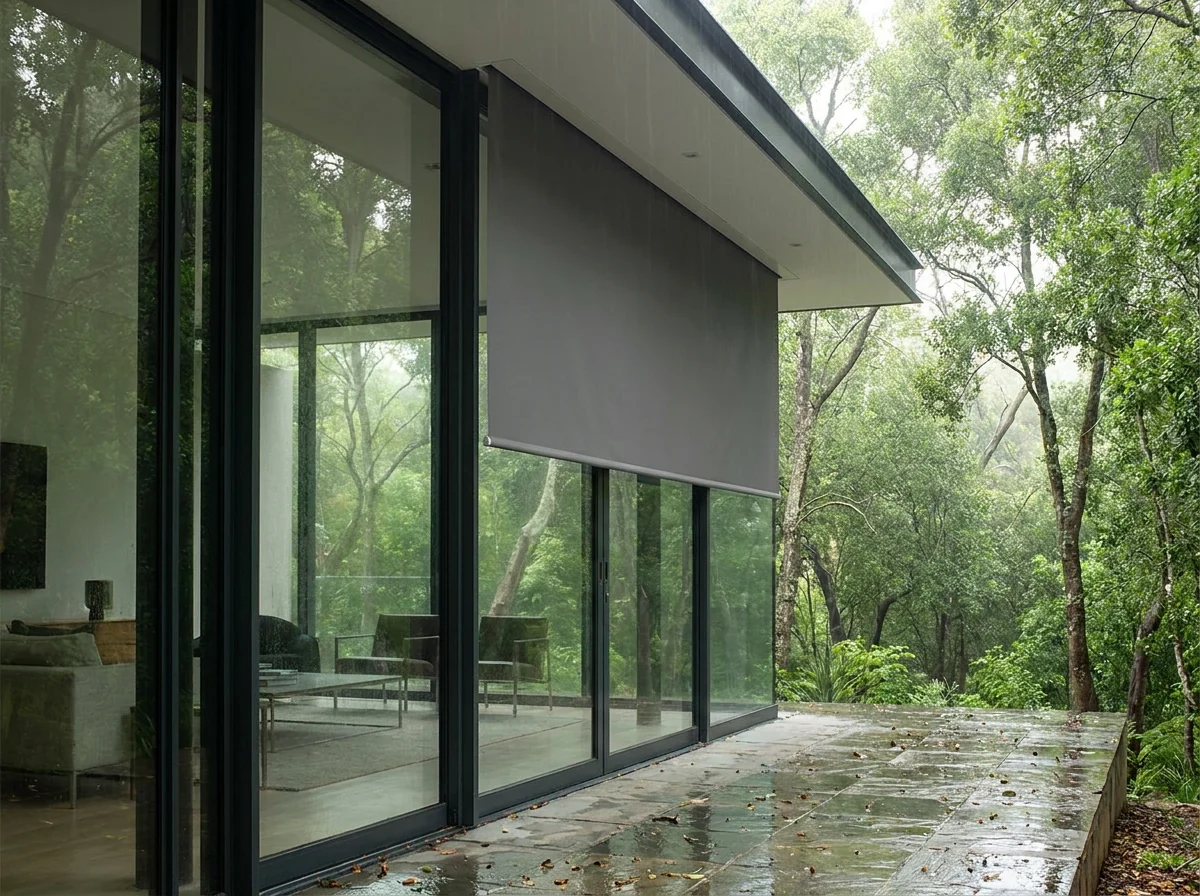
The newer builds here run to frameless corners and double-volume glazing, and a chain hanging four metres down the glass ruins exactly the view the architect drew. A concealed roller drops out of a slim ceiling slot or a plastered bulkhead, so raised, the window shows nothing but glass and frame.
The honest trade-off: concealed systems are almost always motorised — there’s no hand-reach into a ceiling slot — so they cost more and the motor routing has to be planned. On a standard-height window with an easy reach, a neat surface-mounted roller does the same shading job for less.
View by day, privacy by night: the double roller
Where a room wants the sunscreen’s garden view in daylight and a real screen after dark, a double (day-and-night) roller carries both on one bracket — answering the sunscreen’s one weakness, night privacy, without a second blind on the wall.
The honest trade-off: two fabrics on one bracket is a slightly deeper headbox and a bit more cost than a single roller. If a room only ever needs one of the two, a single roller is tidier.
Walls, heritage joinery and the practical side of a big plot
Bishopscourt is a low-density, high-security enclave — high walls, hedges, electric fencing, and a good number of foreign consulates and embassies. Two things follow for a blind fitting. First, heritage joinery: on Cape Dutch-revival and older steel-framed windows we choose an inside- or outside-mount and a fixing that suits the actual timber or steel, rather than forcing a standard bracket into an original sash. A slim venetian headrail or a face-fixed roller often solves a deep reveal without touching the frame.
Second, access. Long screened driveways and gated entrances are noted at the measure so the fitting team isn’t held at a gate with a van full of made-to-measure product. On the newer builds the constraint flips — big frameless openings and double-volume glass that want a concealed head detail planned in early, before the ceiling is closed.
What a photo and a floor plan can’t tell us
This guide gets you most of the way to the right product for each elevation. The last stretch only an in-home measure resolves — and it’s the stretch that decides whether a blind still works in five years or rattles loose in one:
- Exact reveal depth on each window — whether a blind sits inside the frame or has to face-fix above it, which matters most on deep-set Cape Dutch and steel-framed reveals.
- The fixing substrate behind the plaster — brick, timber lintel, steel or a double-volume bulkhead — which decides the bracket, and whether a heavy motorised unit can hang safely.
- How exposed each terrace and upper window really is to the south-easter — the difference between a canopy awning and a taut zip screen, and whether a wind sensor is essential rather than optional.
- Damp and ventilation in the south and canopy-shaded rooms — which fabrics and finishes will hold up, and where sealed aluminium quietly beats timber.
- Motor power routing on concealed and double-volume installations — where the cable runs, whether it’s a battery or wired motor, and what has to happen before a ceiling is closed.
Ready to price it? Two honest ways to start
Want a ballpark first? Pop your rough sizes into the tool below and we’ll send a budget range by the next working day — no visit, no obligation. Not sure how to measure, or you’d rather it was done properly? Leave the sizes: our consultant measures every window free and you get exact per-window pricing. The free measure is the one we’d point you to — the ballpark is just there if you like a number in front of you first.
Book your free expert measure
The one we’d recommend. A consultant measures every window, checks light, fixings, damp and estate access, brings fabric samples, and leaves you with a written, itemised, per-window quote.
We take five or six measure appointments a week across Bishopscourt and the southern suburbs, so the diary tends to fill a week or two ahead — booking early just means you get the day you want.
Or get a rough ballpark first
Discreet and non-binding. Add each window, and we’ll send a budget range by the next working day. Not sure of a size? Leave it blank and note the room — or just book the free measure above and we’ll do the measuring.
| Room | Width (mm) | Drop (mm) | Fit | Product | Remove |
|---|
Where the local facts come from
The climate, geography and suburb facts in this guide are drawn from the sources below. The summer and winter sun angles are worked out from Cape Town’s latitude of about 33.9° south and the standard solar declination, so they’re calculated rather than quoted; everything else is cited.
- Bishopscourt — houses, plot sizes, elevation, Kirstenbosch boundary, Van Riebeeck’s Hedge, consulates: en.wikipedia.org/wiki/Bishopscourt,_Cape_Town
- Southern Suburbs housing stock, era and streetscape: en.wikipedia.org/wiki/Southern_Suburbs,_Cape_Town
- Why the Newlands/Bishopscourt slope is the wettest in the country (up to ~2 000 mm vs <600 mm, orographic winter rain): thetablemountainfund.org.za
- The south-easter “Cape Doctor” — season and strength: en.wikipedia.org/wiki/Cape_Doctor
- Southern-hemisphere sun path (sun in the north; low winter, high summer): harvestingrainwater.com
- Cape Town summer UV index (very high to extreme, Oct–Mar): weatherandradar.co.uk/uv-index/cape-town